<img alt="" src="https://secure.heat6have.com/192007.png" style="display:none;">
Sign In Schedule a Call

BetterRX Guardrails™

BetterRX Guardrails help hospice teams make consistent, cost-effective medication decisions at the point of order with real-time decision support and hospice-defined best practices.

Because “we’ll catch it later” is not a strategy. 


Schedule a Call


Guardrail Hero Image V2

Consistent medication ordering decisions. Predictable costs.

BetterRX Guardrails help standardize medication decisions and improve pharmacy spend visibility across teams and locations.

BetterRX Guardrails Are Easy to Configure

Guardrail Manager™ for Clinical Leaders

The Guardrail Manager provides clinical leaders with centralized management over their BetterRX Guardrails across their organization. Medication choices reflect best practices and align with your philosophy of care.

  • Confidence in team decisions
  • Account- and facility-level flexibility
  • Spend less time training your nurses


Guardrail Manager


More Time for Patient Care

Simplify Frontline Decisions for Nurses. 

BetterRX Guardrails reduce cognitive load for nurses with clearer guidance up front, helping improve medication workflow management and hospice care coordination.
Your nurses did not join hospice to babysit pharmacy spend. 

betterrx-heart
Free teams from cost-related distractions
betterrx-heart
Give nurses clear guidance
betterrx-heart
Improve nurse workflow efficiency


"It's really helped with team satisfaction. Anything that makes their job easier and quicker helps make them happier."


— Mandi Carver, RN, Clinical Manager


Get the Full Story


mandycompassion


Proactive Cost Control

Achieve Confidence in Your PPD

BetterRX Guardrails can be configured to help you reach your PPD goals. In Beta testing, hospices using the Delivery Consolidation Guardrail saw more than 8% lower delivery fees per patient compared to their own pre-enablement baseline.

-8% Deliveries/Patient Median*

*Among hospices with low override rates (<40%)

Achieve predictable PPD 
Avoid invoice surprises 
Real-time visibility on cost savings 

Built for your goals, not PBM drug margins

BetterRX Guardrails align medication guidance with hospice-defined best practices — not PBM margins or pharmacy markups.
Your rules, your goals, your BetterRX Guardrails. 

betterrx-heart
Focus on care quality and cost goals
betterrx-heart
You configure your BetterRX Guardrails
betterrx-heart
Real-time visibility into spend

Frequently Asked Questions

Others frequently ask…
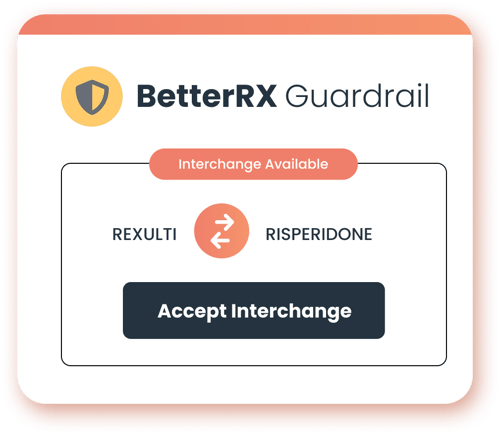
  •  BetterRX Guardrails are a configurable clinical standardembedded directly into a hospice's medication orderingworkflow. Rather than relying on training materials or policymanuals that clinicians must recall from memory during apatient encounter, BetterRX GuardrailsTMpresent best-practice defaults at the moment a prescription is beingplaced. For example, with one medication ordering guardrailcalled Interchange Manager, clinical leaders can set andadjust pre-approved therapeutic alternatives in one place.Then, when a clinician selects a high-cost medication where apre-approved lower-cost clinical equivalent (or interchange)is available, the system automatically presents the hospice'sdesignated alternative before submission. Clinicians retain fullautonomy to choose differently, but they do so with completevisibility into cost and formulary implications, and anyexception is briefly documented, creating a data trail forclinical leadership.

  • Pharmacy medication cost per patient per day (PPD) variesconsiderably across hospice organizations based on censussize, patient acuity, geography, and the rigor of formularymanagement. Published industry data and academic researchsuggest that pharmacy-specific medication costs generallyrun in the range of $10 to $15 per patient per day under well-managed formulary conditions, though organizations withoutactive formulary oversight can run meaningfully higher. Themost actionable benchmark for any individual hospice is itsown trend line: high-performing organizations prioritizeminimizing day-to-day PPD volatility so that no single orderingdecision creates a monthly cost spike. BetterRX client datashows organizations commonly achieving generic utilizationrates above 95%. 
  • Traditional pharmacy benefit managers (PBM) typically operate on a spread pricing model, in which the PBM bills the hospice a higher amount than it pays the dispensing pharmacy and retains the difference as revenue. This spread is generally
    invisible to the hospice: without claim-level transparency, an organization has no way to know how much of its pharmacy
    spend is going to the PBM rather than the pharmacy. In a pass-through
    model, the hospice pays the actual pharmacy acquisition and dispensing costs directly, plus a clearly disclosed administrative fee per claim, with no hidden spread. Pass-through pricing gives hospice financial and clinical leaders
    full visibility into true drug costs, enabling accurate formulary analysis, PPD forecasting, and identification of substitution opportunities that spread-pricing models structurally obscure.
  • Savings from improved formulary compliance depend on an organization's medication utilization, census size, and current prescribing patterns. Every dollar of pharmacy cost saved under Medicare's fixed per-diem model flows directly to organizational margin, because reimbursement is identical regardless of drugnspend. In a documented BetterRX case study, Compassion Hospice
    reduced pharmacy spend by $1.80 per patient per day after implementing Interchange Manager, with their team reporting no negative impact on patient care.⁸ For reference, that reduction
    across a 100-patient census would represent approximately $65,700 in annualized pharmacy savings. These figures are selfreported
    and outcomes will vary by organization; they are best understood as illustrative of what disciplined formulary
    management can achieve rather than as guaranteed results.
  • Hospice pharmacy costs spike for predictable structural reasons. After-hours and weekend ordering creates the highest risk, as coverage clinicians default to familiar choices rather than organization-specific formulary standards when no realtime guidance is available. Clinicians ordering under acute cognitive load, managing multiple patient crises simultaneously, tend to select higher-cost branded or intravenous formulations
    when equally effective oral generics exist. Staff turnover creates recurring knowledge gaps, as new hires lack the formulary
    fluency of experienced colleagues. The most effective prevention is structural rather than educational. Embedding
    approved defaults and real-time alternative alerts directly into the ordering workflow ensures formulary-aligned decisions occur consistently regardless of shift, experience level, or cognitive load. Monthly retrospective reports and periodic
    reminders to "be cost-conscious" have limited impact because they operate outside the decision moment rather than within it.

  • Workflow-embedded clinical decision support means that best-practice guidance appears automatically within the tools clinicians already use to place orders, rather than in separate reference materials, policy manuals, or training courses they
    must separately consult. In the hospice medication workflow, this means a nurse sees real‑time cost information, hospice‑preferred medication selections, and formulary status for every order
    without leaving the screen or calling the pharmacy. BetterRX Guardrails  also manage ancillary fee exposure by
    automatically consolidating orders and limiting STAT or After‑Hours use to medications that truly require it, reducing
    unnecessary fees while keeping care moving smoothly. The support is non-blocking: it informs without interrupting, and the clinician retains full decision authority. Any deviation from the
    suggested default is briefly documented, which creates a data trail that clinical directors can use for targeted, specific coaching conversations. This approach is structurally different from training-based methods, which place the entire cognitive burden of recall on the individual clinician at the moment of highest stress.